
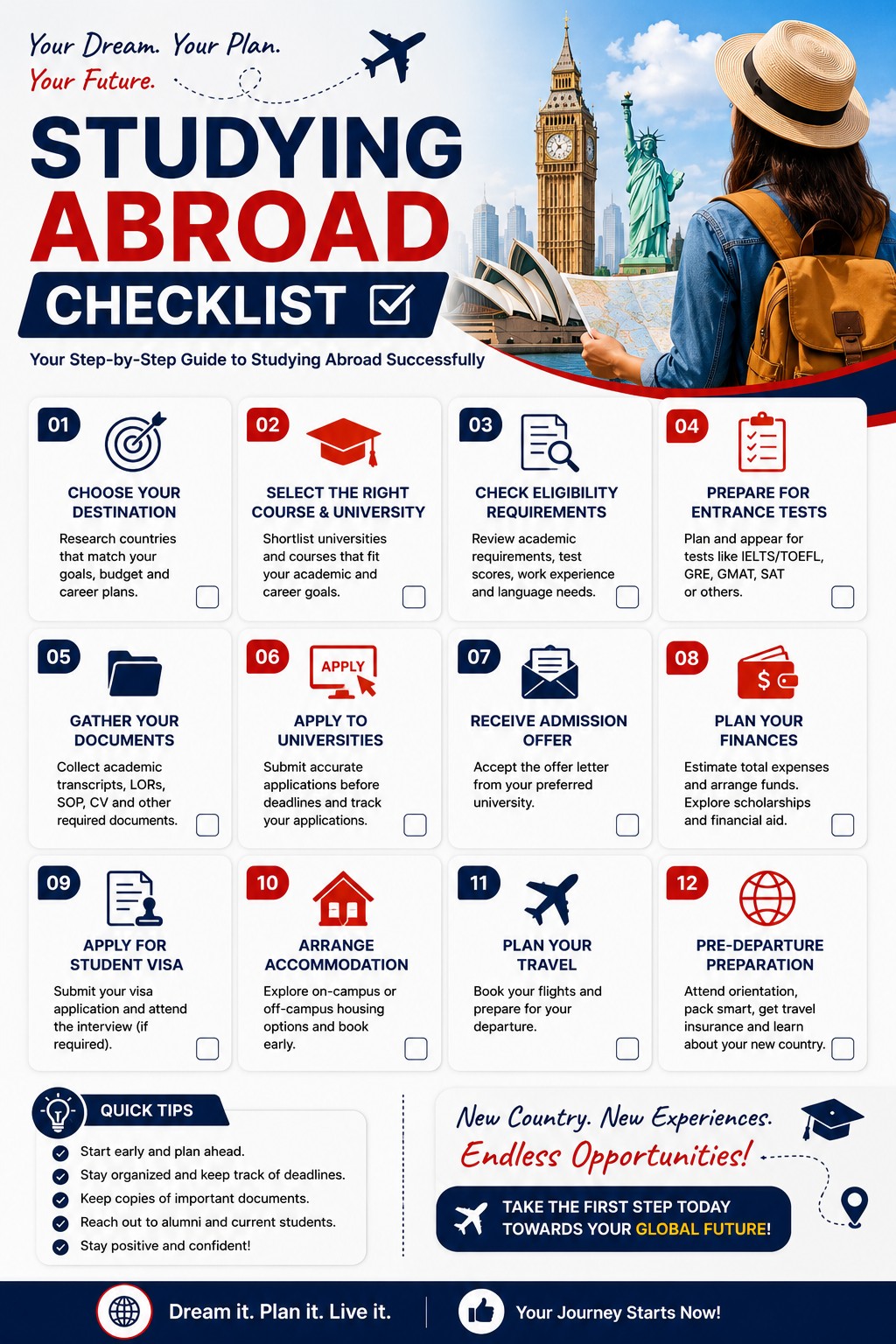
Studying abroad is one of the most transformative decisions you can make. The right international degree can open doors to careers, networks, and opportunities that simply do not exist at home. But the process is complex — choosing the wrong country, course, or consultancy can cost you years and thousands of dollars.
This ultimate guide gives you everything you need to make smart decisions from the very beginning.
Part 1: Why Study Abroad?
The case for international education goes beyond the degree itself:
Global recognition: Degrees from Australia, the UK, Canada, the USA, and New Zealand are recognised by employers in virtually every country. Graduates frequently receive higher starting salaries than domestic graduates in their home market.
Post-study work rights: Most major study destinations now offer post-study work visas, giving you 1–3 years of international work experience after graduation. This is increasingly linked to permanent residency pathways.
Network and exposure: Studying alongside students from 50+ countries builds a professional network that is impossible to replicate at home. Many career-defining connections are made during international study.
Personal development: Living independently in a new country builds resilience, cross-cultural competency, and adaptability — skills that employers consistently rate among the most valuable.
Part 2: Choosing the Right Country
Different countries offer different value propositions for international students.
### Australia
Australia is the world's third most popular study destination. It offers world-class universities (including 8 in the QS Top 100), a friendly visa system for skilled graduates, and clear permanent residency pathways through skilled migration.
- Post-study work rights: 2–6 years depending on course and location
- Permanent residency pathways: Strong, particularly for health, engineering, and IT graduates
- Cost: High — AUD $20,000–$45,000/year tuition; AUD $21,000–$26,000/year living costs
- Best for: Healthcare, engineering, agriculture, education, IT
### United Kingdom
The UK is home to Oxford and Cambridge — two of the world's three oldest universities — and a thriving postgraduate education market. The Graduate Route visa (2 years post-study) has significantly increased the UK's appeal since 2021.
- Post-study work rights: 2 years (Graduate Route); 3 years for PhD graduates
- Permanent residency pathways: Via Skilled Worker visa after graduation; 5 years to ILR
- Cost: GBP £10,000–£45,000/year tuition; GBP £12,000–£18,000/year living costs
- Best for: Business, law, finance, arts, humanities, STEM
### Canada
Canada consistently ranks among the world's most liveable countries, and its study permit system allows students to work 24 hours per week off-campus during term time. Post-graduation work permits of up to 3 years provide an excellent bridge to permanent residency through Express Entry.
- Post-study work rights: 1–3 years (Post-Graduation Work Permit)
- Permanent residency pathways: Among the most accessible globally via Express Entry and Provincial Nominee Programs
- Cost: CAD $15,000–$35,000/year tuition; CAD $12,000–$20,000/year living costs
- Best for: Business, computer science, nursing, engineering, hospitality
### United States
The USA has the most universities ranked in the global top 100 of any country. However, post-study work rights are more limited and complex (OPT: 1 year, STEM OPT: 3 years), and permanent residency through employment (H-1B) requires employer sponsorship through a lottery system.
- Post-study work rights: 1–3 years (OPT/STEM OPT)
- Permanent residency pathways: Complex; employer-sponsored H-1B route is lottery-based
- Cost: USD $20,000–$60,000/year tuition; USD $15,000–$25,000/year living costs
- Best for: STEM, business, film/media, medicine (research)
### New Zealand
Often overlooked, New Zealand offers a high quality of life, excellent universities, and clear permanent residency pathways. It is particularly strong for agriculture, environmental sciences, and hospitality management.
- Post-study work rights: 1–3 years depending on qualification
- Permanent residency pathways: The Skilled Migrant Category provides a clear route
- Cost: NZD $22,000–$40,000/year tuition; NZD $15,000–$20,000/year living costs
- Best for: Agriculture, environmental science, tourism, nursing
Part 3: Choosing the Right Course
When selecting a course, consider these factors in order:
1. Graduate employment outcomes
Research the employment rate of graduates from this specific course at this specific university. Most countries publish this data (Australia: Quality Indicators for Learning and Teaching; UK: Graduate Outcomes Survey; Canada: Graduate Employment Survey).
2. Post-study work visa eligibility
In Australia, courses at regional universities attract longer post-study work rights (up to 2 additional years). In the UK, only courses at licensed Student sponsors qualify for the Graduate Route. Always verify.
3. Accreditation
Professional degrees (medicine, engineering, nursing, law, accounting) require accreditation by the relevant professional body in your home country. A UK engineering degree does not automatically allow you to practice as an engineer in Nepal without assessment by the Nepal Engineers Association.
4. Duration
A 1-year UK Masters costs considerably less in tuition and living costs than a 2-year Australian Masters. However, employer perception of duration varies by industry.
5. Specialisation availability
Some specialisations are only available at specific universities. If you want to specialise in, for example, Islamic Finance, Financial Risk Management, or Sustainable Urban Design, research which institutions have leading programmes.
Part 4: Finding and Evaluating Consultancies
The right education consultancy can transform your experience — from selecting universities to preparing your SOP, navigating visa requirements, and supporting you on arrival. The wrong one can take your money and give you nothing of value.
Signs of a trustworthy consultancy:
- Registered with a relevant industry body or government authority
- Has verifiable reviews on independent platforms (ConsultancyCheck, Google, Trustpilot)
- Has demonstrated success with students going to your target country
- Is transparent about fees and what is included
- Provides clear written service agreements
- Does not guarantee visa approvals (no one can legally do this)
Signs of a problematic consultancy:
- Demands large upfront fees before you have an offer letter
- Guarantees visa approval or places at top universities
- Cannot provide references from past students
- Pressures you to apply to specific universities (often due to commission incentives)
- Provides no written agreement for their services
Search any consultancy on ConsultancyCheck before engaging. Real student reviews give you the clearest picture of what to expect.
Part 5: Scholarships and Funding
International education is expensive, but significant scholarship funding exists:
Government scholarships (destination country funded):
- Chevening Scholarship (UK): Full funding for one year of postgraduate study
- Australia Awards: Full funding for students from developing countries
- Canada's IDRC Scholarships: Research-focused awards
- New Zealand Development Scholarships: For students from developing countries
Institutional scholarships:
Most universities offer merit-based international student scholarships. These typically reduce tuition by 10–30% and are awarded automatically based on your academic results. Apply during the admission process — most do not require separate applications.
Country-of-origin scholarships:
Many governments fund scholarships for their students to study abroad. Check with your Ministry of Education, commercial banks, and large private employers in your country.
Part 6: The Application Timeline
For September/October entry (most common in UK, Canada, Australia second semester):
- 18 months before: Begin country and course research; sit first language test
- 12 months before: Finalise shortlist; apply for scholarships; prepare SOP
- 10 months before: Submit applications to all institutions
- 8 months before: Receive offers; accept preferred offer; apply for accommodation
- 6 months before: Apply for visa; organise financial evidence
- 3 months before: Book flights; arrange insurance; complete pre-departure tasks
- 1 month before: Complete university pre-enrolment; prepare for departure
Part 7: Life After Arrival
The first month in a new country is the hardest. Practical steps that make a significant difference:
- Find your community immediately: Join your university's international student association and your home country's student group on campus
- Set up banking early: A local bank account with a local card is far cheaper than using your home country card for daily expenses
- Register with a doctor: Do not wait until you are unwell. Register with a local GP in the first week
- Understand your visa conditions: Know your work hour limits, attendance requirements, and what happens if your circumstances change
- Use your university's services: Career centres, library, counselling, academic skills support — you are paying for these through your fees
Final Thoughts
Studying abroad is not just an academic decision — it is a life decision. The students who thrive are those who choose their destination, institution, and course based on clear goals, prepare thoroughly, and engage fully with the experience once they arrive.
Start early, do your research, find a consultancy with genuine student reviews, and commit to the process. The preparation is demanding — the rewards are worth it.
Browse 316+ verified consultancies on ConsultancyCheck to find a trusted advisor for your study abroad journey.
Find your perfect consultancy.
Matched to your country & study goals — free.
Frequently Asked Questions
Which country is best for international students in 2026?
It depends on your goals. Australia offers strong permanent residency pathways and long post-study work rights. The UK has globally prestigious universities and a 2-year Graduate Route. Canada offers accessible permanent residency and a welcoming immigration system. New Zealand is excellent for lifestyle and specific fields. Compare based on your career goals, budget, and long-term plans.
How much does it cost to study abroad?
Total annual costs (tuition + living) range from approximately AUD $40,000–$70,000 in Australia, GBP $25,000–$60,000 in the UK, CAD $25,000–$55,000 in Canada, and USD $35,000–$85,000 in the USA. Costs vary significantly by city, institution, and lifestyle.
How do I find a good education consultancy?
Look for consultancies registered with a government body or industry association, search for independent student reviews on ConsultancyCheck and Google, ask for references from past students who went to your target country, and ensure you receive a written service agreement before paying any fees.
Can studying abroad lead to permanent residency?
Yes, in most major destinations. Australia has strong skilled migration pathways for international graduates. Canada's Express Entry and Provincial Nominee Programs actively recruit international graduates. The UK requires switching to a Skilled Worker visa after graduation and spending 5 years on that route. New Zealand's Skilled Migrant Category also recognises international graduates.
When should I start the study abroad process?
Ideally 12–18 months before your intended start date. This allows time for language test preparation, multiple test sittings, scholarship applications (many close 12 months before study commences), and a comfortable visa application timeline.
Find a Verified Consultancy
Browse 800+ consultancies with real student reviews — sorted by rating and verification status.