
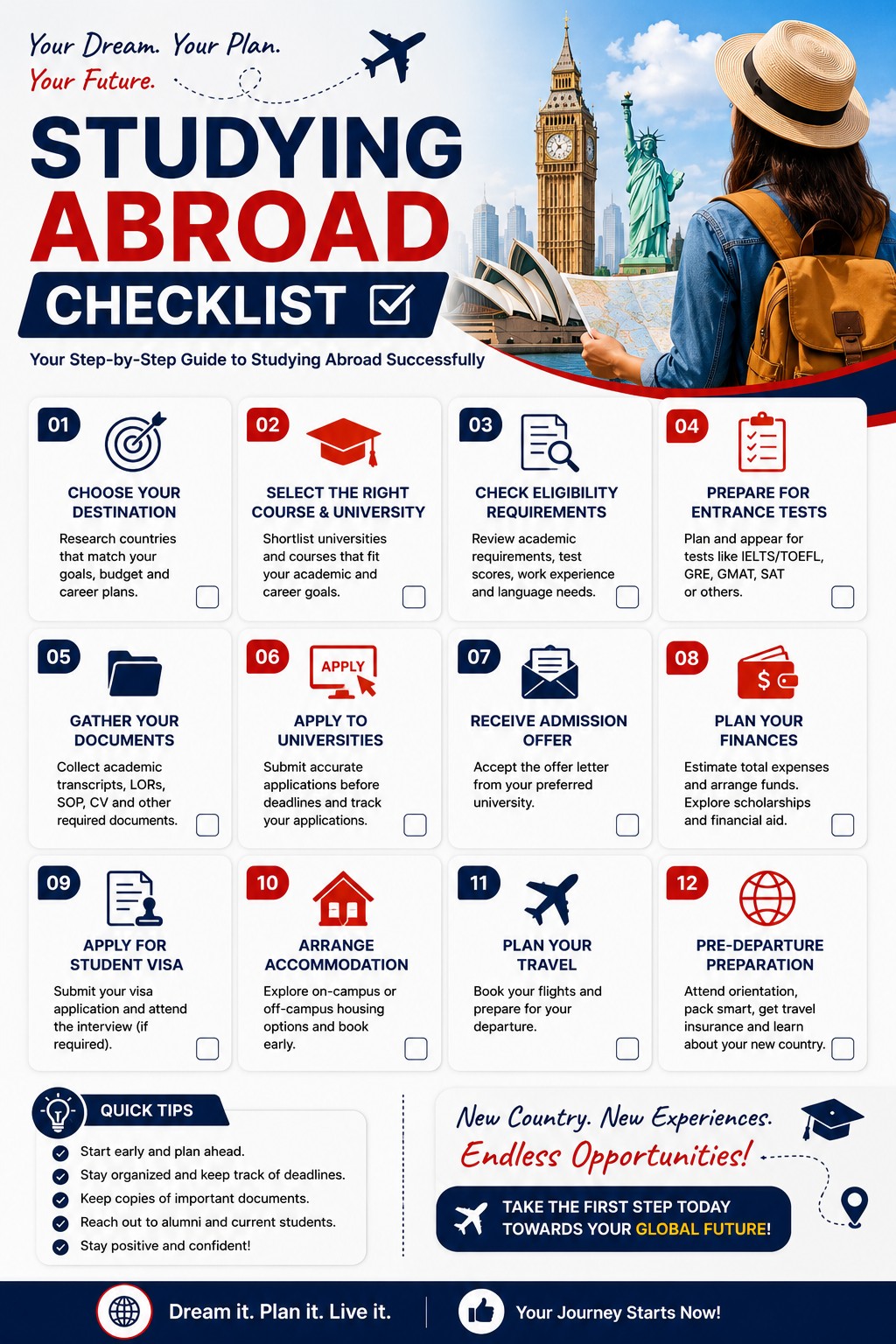
Studying abroad involves dozens of moving parts across a timeline of 12–18 months. Missing a single step — a missing document, an expired medical report, an unpaid fee — can derail months of preparation. This checklist organises every task by phase, so nothing gets missed.
Phase 1: Research and Decision (12–18 Months Before Departure)
Country and course selection
- Research destination countries based on your field of study, career goals, and post-study work rights
- Compare tuition fees and living costs across target countries
- Shortlist 6–10 universities/institutions
- Check entry requirements for each (academic, language, portfolio if required)
- Identify scholarship opportunities — note all deadlines (many are 12+ months before study commences)
Language preparation
- Determine which English language test is required (IELTS, PTE, TOEFL, Duolingo)
- Register for your first test sitting with at least 3 months before application deadlines
- Begin language preparation — most students need 2–4 months of focused study
Financial planning
- Calculate total cost: tuition + living + health insurance + travel + visa fees
- Identify your funding sources: savings, family, bank loan, scholarship
- Begin GIC process if applying to Canada via SDS
- Open a bank account that has low international transaction fees
Phase 2: Applications (9–12 Months Before Departure)
Application preparation
- Obtain official academic transcripts (allow 2–4 weeks for certified copies)
- Request letters of recommendation — give referees at least 4 weeks' notice
- Obtain language test results that meet each university's minimum
- Prepare your Statement of Purpose (SOP) — draft, revise, have reviewed
- Prepare your CV/resume in the format expected by your target country
- Prepare any portfolio (required for art, architecture, design programmes)
Applications
- Submit applications before each institution's deadline (international deadlines are often earlier than domestic)
- Track each application and confirm receipt
- Pay application fees (typically AUD $50–$150 / GBP £20–£50 / CAD $100–$150 per application)
Scholarship applications
- Apply for institutional scholarships at each university you apply to
- Apply for government scholarships (Chevening, Australia Awards, DAAD, etc.)
- Apply for any country-specific scholarships in your home country
Phase 3: Offer and Acceptance (6–9 Months Before Departure)
Receiving and evaluating offers
- Compare all offers received: fee level, scholarship attached, programme structure, location
- Research accommodation options for each institution (on-campus housing waitlists fill fast)
- Accept your preferred offer and pay any deposit or acceptance fee by the stated deadline
- Decline other offers promptly (allows other students to receive those spots)
Accommodation
- Apply for on-campus accommodation immediately after accepting your offer (most have early deadlines)
- Research off-campus alternatives in case on-campus is unavailable
- Understand the lease terms and upfront costs
Phase 4: Visa Application (4–6 Months Before Departure)
Visa preparation
- Identify the exact visa required (Australia: Subclass 500; Canada: Study Permit; UK: Student Visa; USA: F-1)
- Check current processing times — plan to apply well before your programme start date
- Gather required documents (see our document requirements guide)
- Complete upfront medical examination if required (Australia, Canada — must be within validity period)
- Organise certified translations of documents not in English
- Obtain Overseas Student Health Cover (OSHC) or equivalent before applying for your visa
Visa application
- Create your online visa account
- Complete all application forms carefully — errors cause delays
- Pay visa application fee and health surcharge
- Submit biometrics at a visa application centre if required
- Monitor application status online
- Keep your travel plans flexible until visa is granted
Phase 5: Pre-Departure (1–3 Months Before Departure)
Financial preparation
- Activate or obtain an international-friendly bank card (Wise, Revolut, or a bank with overseas ATM access)
- Notify your home bank of your travel
- Arrange a student bank account in your destination country (many can be set up before arrival)
- Convert some cash to local currency for immediate expenses on arrival
Health and insurance
- Confirm your OSHC/health insurance covers your full enrolment period
- Collect enough supply of any prescription medications to last 3–6 months (some medications available at home are not available or are expensive overseas)
- Get any required vaccinations for your destination country
- Obtain copies of your medical history and prescriptions in English
Documents — physical and digital copies
- Passport (minimum 6 months validity beyond your course end date)
- Visa grant letter
- Letter of Acceptance / Confirmation of Enrolment
- Proof of accommodation
- Proof of insurance (OSHC certificate)
- Bank statements showing sufficient funds
- Academic transcripts
- Language test certificate
- Birth certificate
- Store digital copies in Google Drive, iCloud, or Dropbox — accessible from anywhere
University enrolment
- Complete pre-enrolment requirements (online orientation modules, form submission)
- Book airport pick-up or transport from the airport to accommodation
- Register for Orientation Week activities
Phase 6: Arrival and Settlement (First Month)
First week
- Collect your BRP (UK), register with local authority if required
- Set up your local bank account (bring your enrolment letter, passport, and proof of address)
- Register with a local doctor (GP) — do not wait until you are sick
- Set up a local SIM card / phone plan
- Explore campus — locate the library, student services, and international student office
Academic setup
- Attend all orientation sessions — these often include visa compliance briefings
- Understand your attendance requirements (visa compliance in Australia, UK requires minimum 80% attendance)
- Set up your student email, library access, and learning management system
- Meet your academic advisor or course coordinator
Wellbeing
- Connect with your country's student association on campus
- Identify on-campus counselling and mental health services — know where to access support
- Explore your neighbourhood — grocery stores, transport, local services
Emergency Contacts to Save Before You Leave
- Your country's embassy or consulate in your destination city
- Your university's international student office (after-hours number)
- Your insurance company's emergency line (OSHC provider)
- A trusted friend or family member in your home country
ConsultancyCheck Tip
A good education consultancy will guide you through most of these steps and flag anything specific to your nationality and destination. Find a verified consultancy on ConsultancyCheck.
Find your perfect consultancy.
Matched to your country & study goals — free.
Frequently Asked Questions
When should I start preparing to study abroad?
Ideally 12–18 months before your intended start date. This gives you time for language test preparation, multiple test sittings if needed, scholarship applications (which often have early deadlines), and a comfortable visa application timeline.
What documents do I need to study abroad?
Core documents include: valid passport, Letter of Acceptance from your institution, language test results, academic transcripts, bank statements showing sufficient funds, visa application forms, and health insurance. Some countries also require upfront medical exams and specific financial products like a GIC (Canada).
How much money should I have before studying abroad?
As a rough guide, budget for: first year's tuition (paid upfront or by instalment), 12 months of living costs (AUD $21,000–$26,000 in Australia; CAD $15,000–$20,000 in Canada; GBP £12,000–£18,000 in the UK), visa fees, health insurance, and a travel buffer of at least $2,000–$3,000.
Can I study abroad without an education consultancy?
Yes — many students manage the process independently. However, education consultancies add value by knowing which institutions have strong employment outcomes, identifying scholarship opportunities you might miss, reviewing your application documents, and navigating visa requirements for your specific nationality.
Find a Verified Consultancy
Browse 800+ consultancies with real student reviews — sorted by rating and verification status.