
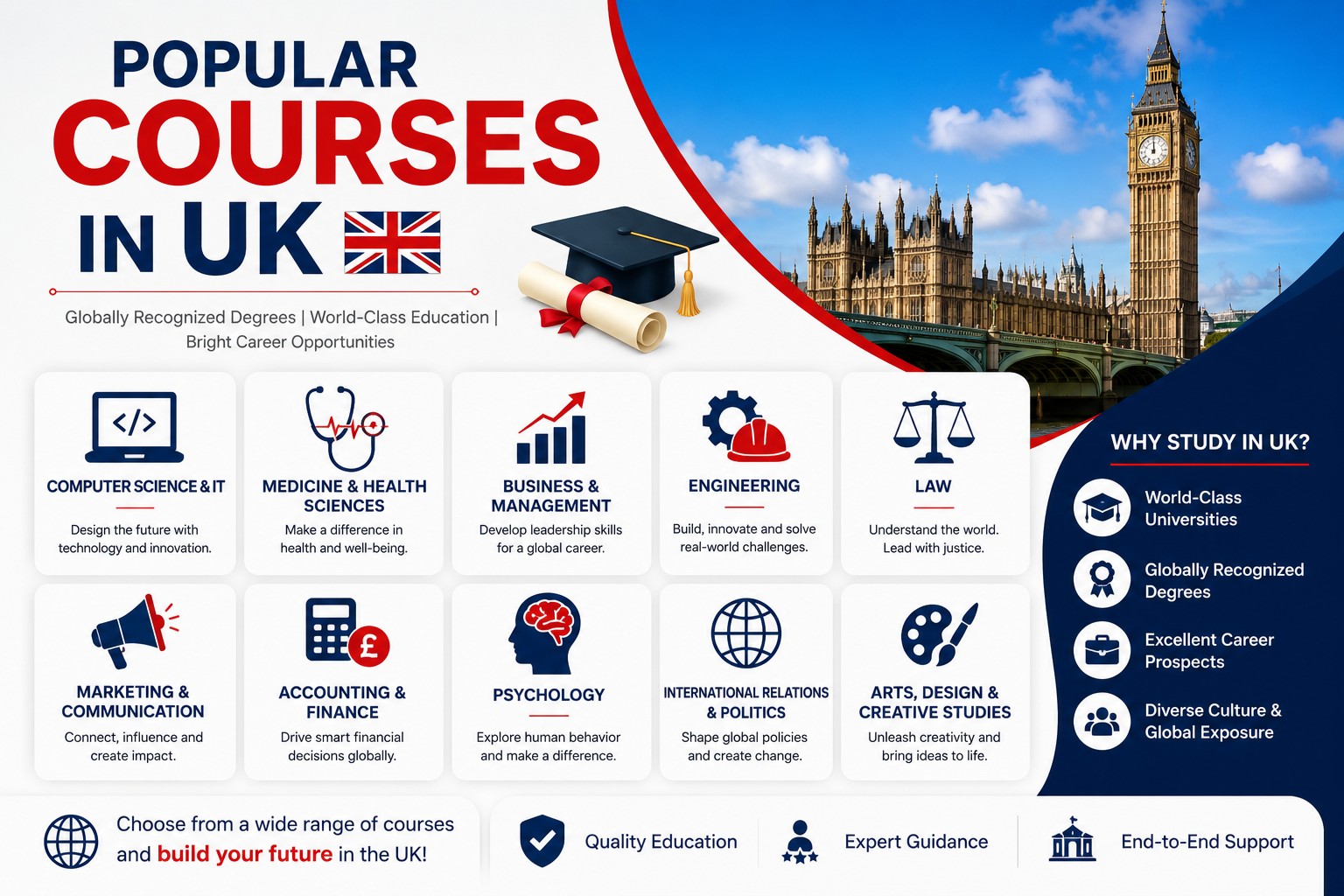
The United Kingdom hosts over 600,000 international students annually, drawn by world-class universities, globally recognised degrees, and a post-study work visa that allows graduates to stay and work for up to two years. But not all courses are equal — some open doors to permanent residency, others attract salary premiums, and a few are simply oversubscribed with international applicants.
Here is a definitive guide to the most popular and most rewarding courses for international students in the UK in 2026.
Business and Management
Business degrees remain the single most popular choice for international students in the UK. Programmes range from broad Bachelor of Business Administration (BBA) degrees to specialist MBA programmes at institutions like London Business School, Said Business School (Oxford), and Judge Business School (Cambridge).
Why international students choose it: High employability, globally portable credentials, and access to London's financial hub. Many universities offer placement years, which provide real-world experience and often lead to full-time offers.
Top universities: London School of Economics, University of Warwick, University of Bath, University of Exeter.
Average graduate salary (UK): £28,000–£45,000 at entry level; significantly higher in London finance.
Computer Science and Artificial Intelligence
Tech roles in the UK are among the fastest-growing sectors, and demand for computer science graduates consistently outstrips supply. Specialist programmes in Artificial Intelligence, Machine Learning, and Data Science have exploded in popularity since 2022.
Why international students choose it: High starting salaries, flexible work options (many roles are remote-friendly), clear pathway to skilled worker visas, and the UK's growing tech sector in London, Manchester, and Edinburgh.
Top universities: Imperial College London, University of Edinburgh, University of Southampton, King's College London, University of Manchester.
Average graduate salary (UK): £32,000–£55,000 at entry level; senior roles exceed £80,000.
Law
UK law degrees (LLB) are globally respected, and the UK's legal system underpins much of international commercial law. International students often study UK law as a stepping stone to legal careers in their home country or internationally.
Note: From 2026, qualification as a solicitor in England and Wales requires passing the Solicitors Qualifying Examination (SQE), which international graduates can sit regardless of where they studied law.
Top universities: University of Oxford, University of Cambridge, University College London, London School of Economics, University of Edinburgh.
Average graduate salary (UK): £25,000–£50,000 (training contracts at top firms pay £50,000+).
Engineering
The UK has a strong engineering tradition, and British engineering degrees are recognised globally. Mechanical, Civil, Chemical, and Electrical Engineering are the most popular disciplines, with Aerospace Engineering growing rapidly.
Accreditation matters: Degrees accredited by the Institution of Engineering and Technology (IET) or the Institution of Mechanical Engineers (IMechE) carry the most weight internationally.
Top universities: University of Cambridge, Imperial College London, University of Manchester, University of Bristol, University of Nottingham.
Average graduate salary (UK): £28,000–£42,000 at entry level; Petroleum and Chemical Engineers earn more.
Medicine and Dentistry
The UK trains some of the world's best doctors. MBBS and BDS programmes are highly competitive — international applicants typically need near-perfect A-level equivalents and must sit the UCAT or BMAT entrance exam. Tuition fees for medicine can reach £45,000 per year for international students.
Key consideration: Many international medical graduates use UK training as a pathway to specialisation, then return home or move to countries like Australia, Canada, or the UAE with UK medical credentials carrying significant weight.
Top universities: University of Oxford, University of Cambridge, University of Edinburgh, King's College London, University of Glasgow.
Architecture and Design
The UK's architecture schools consistently rank among the world's best. The Bartlett School of Architecture (UCL) and the Architectural Association are globally famous. Design degrees — from product design to fashion — benefit from proximity to London's creative industries.
Top universities: University College London (Bartlett), Architectural Association, Royal College of Art, University of the Arts London.
Finance and Economics
Closely related to Business, dedicated Finance and Economics degrees are particularly popular with students from South and East Asia who plan careers in banking, investment, or financial policy. The CFA Institute recognises many UK Finance programmes, allowing graduates to count their degree toward CFA exam exemptions.
Top universities: London School of Economics, University of Warwick, University of Exeter, City, University of London (Bayes Business School).
Hospitality and Tourism Management
Underrated by many, Hospitality and Tourism Management from institutions like the University of Surrey and Oxford Brookes provides internationally transferable qualifications. Graduates work in hotel management, events, aviation, and cruise lines globally.
Top universities: University of Surrey, Oxford Brookes University, University of Strathclyde.
How to Choose the Right Course
When selecting a course as an international student, consider:
- Graduate visa eligibility: All courses at UK universities qualify graduates for the Graduate Route (2-year post-study work visa). However, courses at alternative providers may not qualify — always verify.
- Accreditation: Professional accreditation (law, engineering, medicine) directly impacts your career in your home country. Check that UK accreditation is recognised by the relevant body in your country.
- Employability data: UK universities publish graduate employment data under the Graduate Outcomes Survey. Check this before committing to a course.
- Location: London offers the most networking opportunities but also the highest cost of living. Cities like Manchester, Edinburgh, and Bristol offer strong employment prospects at lower costs.
ConsultancyCheck Tip
An education consultancy specialising in UK applications can be invaluable — they know which universities have strong international student support, which courses have the best employment track records, and how to navigate the UK visa system. Find a verified UK consultancy on ConsultancyCheck.
Find your perfect consultancy.
Matched to your country & study goals — free.
Frequently Asked Questions
Which course is best for international students in the UK?
It depends on your career goals. Computer Science and Business are the most popular for employability. Medicine and Law offer globally respected credentials. Engineering and Finance offer strong salary outcomes. Choose based on your long-term career plans, not just popularity.
Can I work while studying in the UK as an international student?
Yes. International students on a Student visa can work up to 20 hours per week during term time and full-time during official vacation periods. This applies to most degree-level courses at universities.
What is the UK Graduate Route visa?
The Graduate Route allows international students who complete a degree at a UK university to stay and work in the UK for 2 years (3 years for PhD graduates) without a job offer. It is available to students who studied at a licensed Student sponsor.
Are UK degrees recognised internationally?
Yes, UK degrees are among the most widely recognised globally. Employers in Australia, Canada, the UAE, Singapore, and across Europe actively recruit UK graduates. Professional degrees (medicine, law, engineering) require additional local accreditation checks.
Find a Verified Consultancy
Browse 800+ consultancies with real student reviews — sorted by rating and verification status.